
Driving Advocacy with Data & Insights National Center for Missing and Exploited Children
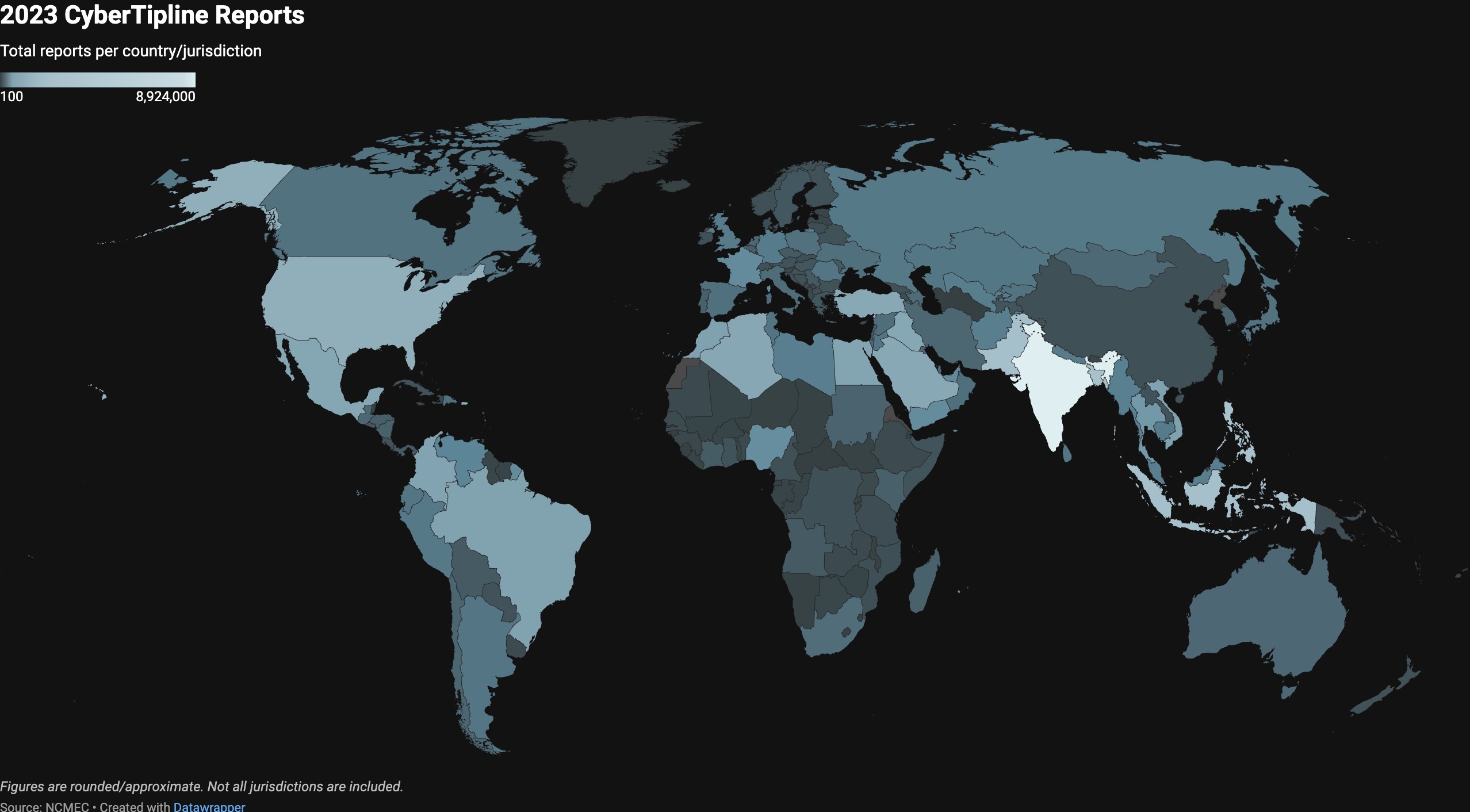
Select a jurisdiction from the map, search box, or list

Featured

Emerging Policy Issues
  • NCMEC testifies before U.S. Congress

    December 10, 2025


    On December 9, 2025, the Senate Judiciary Committee held a hearing on “Protecting Our Children Online Against the Evolving Offender.” Senators heard from NCMEC and other witnesses, including Tamia Woods, who is featured on the Global Platform for Child Exploitation Policy with Tim Woods sharing about why they created the Do It For James Foundation. NCMEC shared updated information about trends related to financial sextortion, sadistic online exploitation, and GAI CSAM.


    On December 10, 2025, the Cybersecurity, Information Technology, and Government Innovation Subcommittee of the House Oversight and Government Reform Committee held a hearing on “Using Modern Tools to Counter Human Trafficking.” At this hearing NCMEC shared insights about child sex trafficking trends and its use of technology and data analytics to help identify, locate, and protect children victimized by sex trafficking.


    Being available for and participating in hearings such as these are important aspects of NCMEC’s policy and legislative advocacy. Other stakeholders should consider seeking similar access to help inform and advise legislative bodies in their respective jurisdictions.

  • European Parliament calls for strengthened child safety rules

    November 26, 2025


    The European Parliament “adopted a non-legislative report…expressing deep concern over the physical and mental health risks minors face online and calling for stronger protection against the manipulative strategies that can increase addiction and that are detrimental to children’s ability to concentrate and engage healthily with online content.”


    In what is essentially a policy advocacy statement, Parliament called for “a harmonised EU digital minimum age of 16 for access to social media, video-sharing platforms and AI companions, while allowing 13- to 16-year-olds access with parental consent”, continued development of an EU age verification solution, and possible personal liability for online platforms’ senior managers. Other recommended actions include bans on certain addictive practices and features, non-compliant services, engagement-based recommender systems for minors, and financial incentives for children acting as influencers.


    For more information, see the press release: “Children should be at least 16 to access social media, say MEPs

  • UN Convention against Cybercrime opens for signing in Hanoi

    October 25, 2025


    The government of Vietnam hosted a signing ceremony, attended by representatives from about 110 countries, for the United Nations Convention against Cybercrime (the “Hanoi Convention”). More than 70 countries signed the Convention, initiating respective ratification processes for each to become a State Party. According to Article 65(1), the Convention will enter into force 90 days after at least 40 Member States become Parties.


    For more information, including NCMEC’s advocacy, see: “UN General Assembly adopts Convention against Cybercrime

  • European Parliament to consider strengthened child safety rules

    October 16, 2025


    The European Parliament’s Internal Market and Consumer Protection Committee adopted a report with recommendations related to online age restrictions for children, personal liability for online platforms’ senior management officials, bans on engagement-based recommender algorithms, disincentivizing minors acting as influencers, and other topics. The full Parliament is expected to vote on these recommendations during its November 24-27 session.


    See the press release: “New EU measures needed to make online services safer for minors

  • January-June 2025: Sharp increases in certain report types

    September 4, 2025


    NCMEC published a blog post--Spike in online crimes against children a “wake-up call”—revealing alarming increases in certain types of reports to the CyberTipline during the first half of 2025, compared to the same period of 2024. The post details 2024 and 2025 report totals related to online enticement, sadistic online exploitation, financial sextortion, generative artificial intelligence, and child sex trafficking.


    More complete CyberTipline data for January-June 2025 will be published on the Global Platform for Child Exploitation Policy later this year.

  • Supreme Court decision brings age assurance clarity (U.S.)

    June 27, 2025


    The U.S. Supreme Court issued its opinion in Free Speech Coalition v. Paxton, a case challenging a Texas law that requires pornography websites to use age verification measures to prevent minors from accessing harmful content. The Court upheld the Texas law, likely paving the way for similar legislation already enacted or under consideration in more than 20 other states.


    While other non-U.S. jurisdictions—such as the U.K. and France—had already adopted similar age verification mandates for pornography platforms, this ruling is significant in the U.S. because of vigorous debates about where age assurance responsibility should be assigned. Online platforms (e.g., Meta, Match Group, Pornhub) and app distribution services (e.g., Apple, Google) have each asserted that the other should bear age assurance responsibility. Various laws imposing requirements exclusively on platforms or app store operators have emerged, both within the U.S. and beyond (Singapore has enacted what is believed to be the first national-level age assurance mandate for app distribution services).  


    NCMEC takes the position that age assurance should be a shared responsibility, not exclusively assigned to either online platforms or app distribution services. Implementation across the connected ecosystem will best address gaps associated with shared devices, children accessing adults’ accounts, school-issued devices, web browser access to avoid platforms’ apps, etc. A more detailed position statement from NCMEC will be published on the Global Platform for Child Exploitation Policy in the coming weeks.

  • Recast directive on child sexual abuse (EU)

    June 17, 2025


    The European Parliament voted to adopt a position supporting a revision to the EU’s Child Sexual Abuse Directive. The proposed changes include increasing criminal penalties, eliminating statutes of limitations, criminalizing the use of AI to commit child sexual abuse offenses, and providing support services to victims at no cost.


    NCMEC will continue to monitor the progress of this directive, which will now be subject to negotiations between the European Parliament and the Council of the European Union.


    https://www.europarl.europa.eu/RegData/etudes/ATAG/2025/772904/EPRS_ATA(2025)772904_EN.pdf

  • Final draft industry codes (Australia)

    May 21, 2025


    Australia’s eSafety Commissioner has received the final draft of industry codes intended to protect children from certain harmful content online. eSafety will evaluate the codes for compliance with the Online Safety Act before deciding whether to accept and register them, at which point they will come into effect. If the codes are rejected as insufficient, eSafety may then impose mandatory standards that do comply with the Online Safety Act.


    Australia’s eSafety model serves as an example of how other jurisdictions may approach regulation of online platforms to ensure online safety for children. The effects of eSafety’s work may also impact populations beyond Australia.

  • REPORT Act’s First Anniversary (U.S.)

    May 7, 2025


    On May 7, 2024, the REPORT Act was signed into law in the U.S., marking a significant advancement in the fight against online child sexual exploitation. Among other modifications, the REPORT Act requires online platforms to report online enticement and child sex trafficking to the CyberTipline for the first time and requires platforms to maintain material relating to a CyberTipline report for up to one year. The law is already making a major impact.


    Online enticement reports to NCMEC’s CyberTipline rose from a monthly average of 42,230 in the last 6 months of 2024 to a monthly average of 69,636 for the first 4 months of 2025.


    Child sex trafficking reports received by NCMEC’s CyberTipline in the first 3 months of 2025 exceeded the total child sex trafficking reports received in all of 2024.


    See NCMEC’s REPORT Act guidance for more information.